Показват се публикациите с етикет Fiqh. Показване на всички публикации

петък, 8 февруари 2013 г.

Sufism 1

Sufism is not from Islam
By Shaykh Fawzan

Questioner: What is the ruling in Islam concerning Sufism?

Shaykh Fawzan: Sufism, there is no Sufism in Islam, this is an innovation. Sufism is an innovation, it is not from Islam.                        
Thus it is upon those who have fallen into Sufism to repent to Allah the Exalted.
And it is upon them to return to the Sunnah.
And it is upon them to return to that which the pious predecessors were upon from uprightness and firmness upon the Deen of Allah and following the Messenger, peace and blessings of Allah are upon him, and following the rightly guided successors.
This is the pure unadulterated methodology.
The Messenger of Allah, peace and blessings are upon him said:

This nation will divide into seventy three sects all of them will be in the fire except one. They said: Who are they oh Messenger of Allah? He replied: Those who are upon what I and my companions are upon.

Thus there is no safety and security except by following the Minhaj of the Messenger of Allah, peace and blessings are upon, him and his companions.
And Sufism is not from the Minhaj of the Messenger, peace and blessings of Allah are upon him, and it is not from the Minhaj of his companions, and it is not from the Minhaj of the virtuous generations; rather it is something newly invented in Islam.
And it (Sufism) contains a great deal of deviations; some of which contains grave worship and shirk with Allah the Exalted and belief in the dead.
Thus Sufism also contains polytheism.

Translated by Rasheed ibn Estes ibn Estes Barbee
from: http://mtws.posterous.com/sufism-is-not-from-islam-explained-by-shaykh
понеделник, 4 февруари 2013 г.

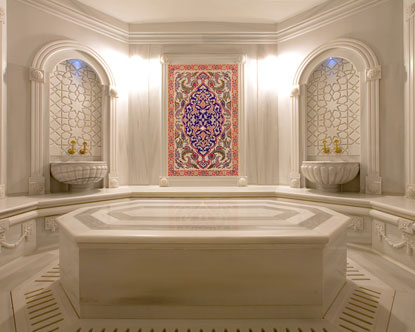
Moroccan Bath-haram

Sisters, no Moroccan Baths, Hammam, Spa treatments and others where you have to expose your body !

It is strictly forbidden for men to enter saunas without an Izar (garment worn below the waist). It was authentically reported in the Hadith narrated by Jabir (may Allah be pleased with him) that the Prophet (peace be upon him) said:

"Whoever believes in Allah and the Day of Resurrection, let him ...not go to public baths except while wearing an Izar." (Related by Al-Nasa'y and Al-Hakim, and ranked as Sahih (authentic) according to the conditions of Muslim)

This Hadith has corroborating reports. Women are forbidden from entering public baths. It was reported from `Aishah (may Allah be pleased with her) that she told some women who came to her, "Are you the ones whose women enter public baths? I had heard the Messenger of Allah (peace be upon him) saying:

"A woman who removes her clothes in other than her husband's house tears the veil between her and Allah." (Related by Ahmad, Abu Dawud, Al-Tirmidhy, Ibn Majah, and Al-Hakim, and ranked as Sahih according to the conditions of Al-Bukhari and Muslim. Al-Dhahaby agreed with him.)
 

It was related in “Musnad (Hadith compilation of) Imam Ahmad", and ranked as Hasan (good) by Al-Hafizh Ibn Kathir, that `Umar ibn Al-Khattab (may Allah be pleased with him) said: "O people! I heard the Messenger of Allah (peace be upon him) saying, 'A person who believes in Allah and the Day of Resurrection should not sit at a table where there is Khamr (intoxicants); a man who believes in Allah and the Day of Resurrection should not enter a public bath without an Izar; and a woman who believes in Allah and the Day of Resurrection should not enter a public bath.''

The Permanent Committee for Scholarly Research and Ifta'
[Bakr Abu Zayd, Salih Al-Fawzan , `Abdullah ibn Ghudayyan, `Abdul-`Aziz Al Al-Shaykh , `Abdul-`Aziz ibn `Abdullah ibn Baz ] ♥

Islamic insurance explained

Takaful


 Historically

Islamic concept of Takaful was introduced about 30 years ago. Started in Malaysia, in 1984,but must have been developed years before.So the concept is fairly new. However, it did not bring anything new.The concept was already there in the Quran and Sunnah.


Proof form Quran and Sunnah
The concept was already there like paying the blood money. The Islamic system of insurance embodies the elements of shared responsibility, joint indemnity, common interest and solidarity.

Muslim jurists conclude that it should be on the basis of mutuality and co-operation. In conventional insurance, indemnity and profits are not shared.

Rulings and Regulations

1. Policy holders cooperate among themselves and share common goals.

2. The subscription of each policy holder is like a donation and intended to spread the cost and liability across community pooling system.

3. No advantage at the cost of others.

4. Not like conventional Insurance to pay and recieve nothing in case of loss.

5. In conventional insurance, one is treated as a client, while in Takaful, one is a partner.

6. All funds must be invested in halal investments.

7. Part of the money is considered as Tabarruh (donation) and part of the money is invested.

8. The Tabarruh part covers in case of loss, while the invested part is invested and you get a return on it proportionate as agreed with the operator of Takkaful.

9. In case one dies before maturity of his takaful, he will receive whatever he has paid prior to his death from participant's account, and also his share of profits from the investments which have been credited to the participant's account. From His special account any outstanding takaful instalments which would have been paid by the deceased participant should he survive would be calculated from the date of death to the date of maturity of his takaful plan and also be given


Proof of Tabarruh

1. Bukhari narrates that the companions would put all their food into one central basket while on their jihad or dawah. They would eat from it and in case of leftover would divide it equally. This was called Al-Nahar.

2. Gifts to take back. Abu Bakr gave a portion of dates from his farm to Ayesha. She did not claim, so he took it back and advised to divide it after his death among all his children. It was like Tabbaruh, where the left over is dividing among the participants.

Types of Takaful Business

1. Family Takaful Business, General Takaful Business, Commercial Business
Difference Between Conventional Insurance and Takafful:

For detailed explenation, request ''Takaful explained'' file (14 pages): nik.vessy@gmail.com

събота, 30 юни 2012 г.

Change our intention


What happens if we were to change our niyyah while performing an action?

Ibn Rajab al-Hanbali says according to the ulama' if the niyyah at the end of the action matches the beginning (i.e. doing the action for the sake of Allah), then any changes in the middle of the action will be forgiven or does not matter, insha Allah.

However, if the niyyah at the end does not match the beginning, i.e. we do the action for other than the sake of Allah, then we must repent (taubah).


Acquiring knowledge

The Messenger of Allah (sallallahu alayhi wassalam) said:

 "Acquiring knowledge is compulsory for every Muslim. (At-Tabarani)

This narration applies equally to men and women. "Knowledge" in this context refers primarily to knowledge of the Holy Qur'an and Sunnah as no Muslim should be ignorant of his or her Faith, but it also covers other areas of general education, which can contribute to the welfare of civilization.

Exept graveyard

Rasulullah sallallahu 'alaihi wasallam said:

 "All the earth is a mosque apart from the graveyards and bathrooms." (Narrated by al-Tirmidhi, 317)

قول النبي صلى الله عليه وسلم : " الأرض كلها مسجد إلا المقبرة والحمام

 Points learned from Hadith :

1: Praying in graveyard is not allowed exept salatul-Janaza .
2: Two places metioned in this Hadith where pray is not allowed .
There are other Hadith where few other places are metioned .

"The Prophet prohibited Salat from being performed in seven places: the dung heap, the slaughtering area, the graveyard, the commonly used road, the wash area, in the area that camels rest at, and above the Ka'bah. [Tirmidi]
 

понеделник, 25 юни 2012 г.

Correspondence between young men and women


Shaykh Ibn Jibreen (may Allaah preserve him) was asked: What is the ruling on correspondence between young men and women, if this correspondence is free from immorality and love?

He replied:

It is not permissible for any man to correspond with a woman who is not his mahram, because of the fitnah (temptation) involved in that. A person may think that there is no fitnah, but the Shaytaan will ke...ep trying until he tempts him. The Prophet (peace and blessings of Allaah be upon him) commanded those who heard of the Dajjaal to keep away from him, and said that a man may approach him as a believer, but the Dajjaal will keep trying until he leads him astray.

Correspondence between young men and women involves a great deal of fitnah and danger, so we must avoid it, even though the questioner says that this correspondence is free from immorality and love.

From Fataawa al-Mar’ah, compiled by Muhammad al-Musnad, p. 96. [IslamQ&A]

петък, 15 юни 2012 г.

Jihaaad ! Kalifaaat ! Sha'riah for ..


Jihaaad ! Kalifaaat ! Sha'riah for Australiaaa ! wait a moment ya akhi,

Shaykh al-Albaani: ''How do these people get ready to go for Jihad when they are yet to understand what is obligatory on them of Aqeedah ??!!
This my brother, leads us to understand that Jihaad is not to be discussed, but we must discuss its introductions.
The first introduction is, as we attest before Allah, the khalifa.... Because if the amirs exist today and the bond I talked about (common understanding of Islam) does not exist among them then they will turn against one another and fight each other.
They must be all for one methodology and one understanding.
I therefore advise every muslim to work by the hadeeth of Ibn al-yaman, leave all the groups and stay by yourself. And this is not to mean to live in isolation, no it means not to join one or another group. You can do yourself and all the Muslims good with your knowledge.
This is a reminder and the reminder benefits the believers. '' [''Debate with a Jihadi'']